
Live · 3D experience
Splat Walk
Inspect a captured cave-lion head with native three.js Gaussian splats, free-flight controls, and interactive details.
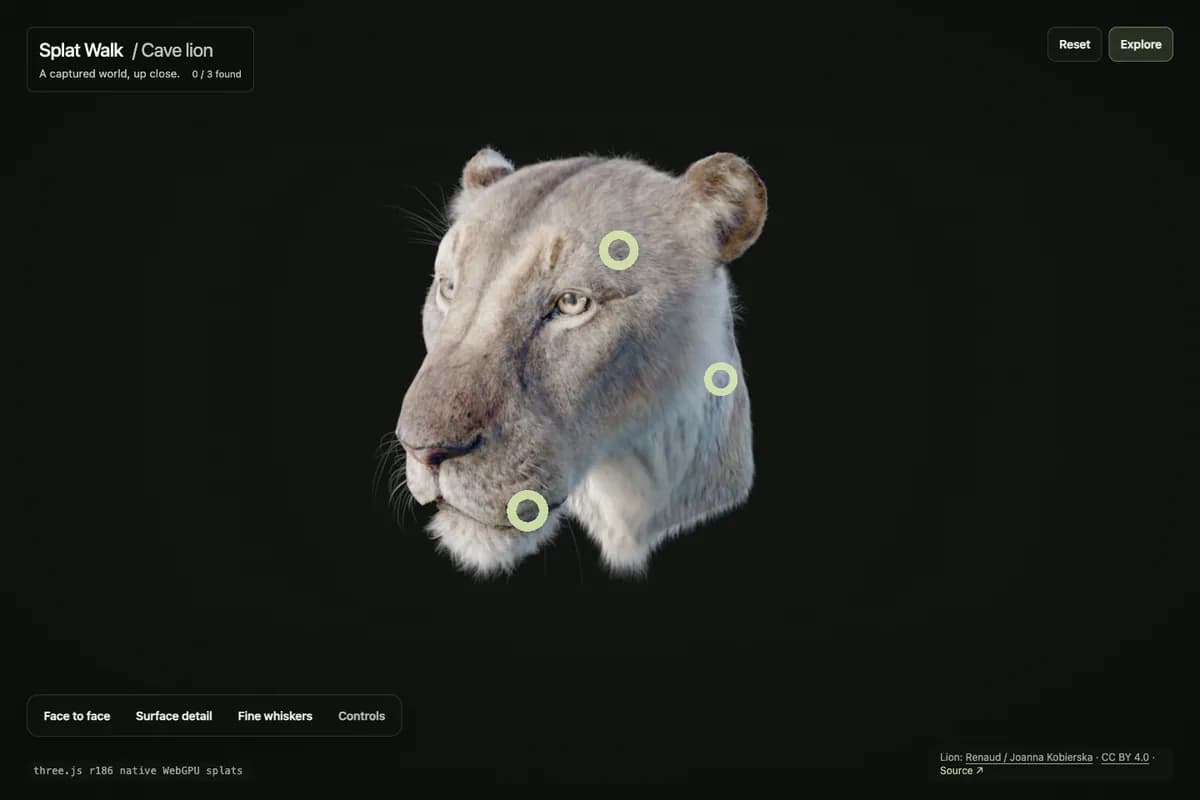
Overview
An object-inspection experiment built around a captured cave-lion head. Move around the scan, inspect three annotated details, and compare how the capture looks from another angle. Despite the name, the current scene is not a room-scale walk or a platform game.
Before you try it
What to try
Inspect a detail
Choose Face to face, Surface detail, or Fine whiskers in the dock. These keyboard-focusable buttons open the same details as the rings on the capture.
Change your viewpoint
Choose Explore for mouse capture, then use WASD to move and Q/E for height. Escape releases the mouse. Without mouse capture, drag to look or focus the canvas and use arrow keys. On touch, the left half moves and the right half looks.
Return without losing discoveries
Choose Reset view to restore the starting camera while keeping the details you found. Refreshing the page starts a new discovery session.
How it works
- The capture is the visual
- three.js renders the Gaussian splats through its native WebGPU renderer and SPZLoader. Scene picking and the HTML detail controls share the same annotations. There is no mesh standing in for the scan.
- Loading and recovery are part of the interface
- Each loading attempt fetches the SPZ once. Progress uses the response length when available. GPU loss ends that attempt and removes the dead canvas; retry creates a new renderer. Hidden tabs pause rendering, and cleanup releases the scene resources.
Related work
Build something related
Building an unusual browser prototype?